Name That Animal: Challenge #3

What would you name this unique animal? Image from pinterest.

It has been a while since I have posted a Name That Animal Challenge, so here is Challenge #3!

Pretend that you are a scientist and you have just discovered this new species and you have the privilege of naming it. Scientists usually name new species by using Greek or/and Latin roots because the prefixes, stems, and suffixes are just like building blocks that you can utilize in countless ways.

Your challenge is to name the unique animal in the picture above using your knowledge of Greek and Latin roots. Keep in mind that you can use characteristics like size, color, or shape to name the animal. Feel free to search my blog to find root words to help you or use the list below.

Greek:

hipp                            horse

cephal                       head

pter                             wing

lepid                           scale

micr*                          small                                *used as a prefix

morph                       form, shape

Latin:

mari                            sea

equ                             horse

corp                            body

capit                           head

*- iform                      shape                        *used as a suffix

I came up with hippolepidopter or scaly winged horse. The letter “o” is the most common way to link Greek roots. The letter “i” is used to link Latin roots.

It’s not too late to participate in Name That Animal Challenge #1 and Name That Animal Challenge #2. Have fun!
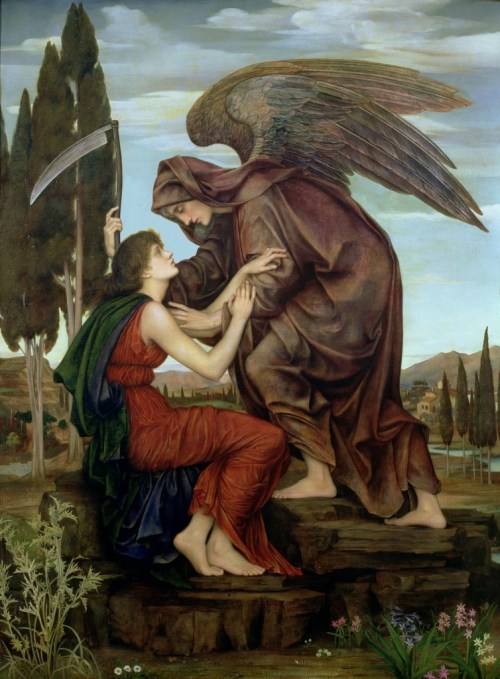
thanatophobia (than-ət-ə-ˈfō-bē-ə)

Thanatos was the primordial Greek god of death. "Angel of Death" by Evelyn DeMorgan, 1881.

To continue our Halloween theme this month, let’s take a look at another phobia. Thanatophobia is the fear of death. Thanatos was the primordial Greek god of death. It was said that he appeared to mortals when the time for them to die was imminent in order to guide them to the Underworld. No one could escape death, therefore Thanatos was feared by all.

Thanatos is often depicted in art as a young man with wings, symbolizing the ability to guide souls to the Underworld. Other symbols include a sheathed sword representing a peaceful passing and a reversed torch representing the end of life.

Other words that are derived from Thanatos are “thanatology” and “euthanasia.”

ailurophobia (ī-ˌlu̇r-ə-ˈfō-bē-ə)

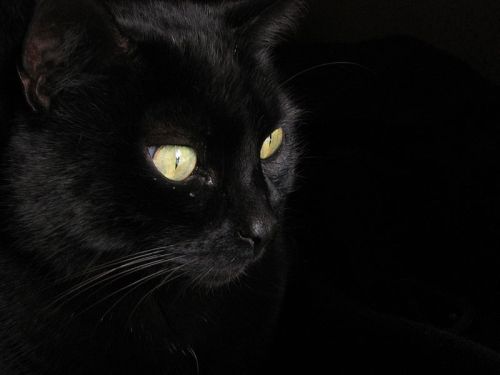
Ailurophobia is the fear of cats. "Gato negro" by Chosovi. Distributed under license CC BY-SA 2.5 via Wikimedia Commons.

As Halloween approaches, people are busy decorating their houses with scary looking spiders, skeletons, and witches. Images of black cats are also a common decoration for Halloween; I see black cats with haunting eyes everywhere! In the United States, black cats are considered bad luck. But in other countries, like Japan, black cats are thought to bring good luck. For the last several months, a black cat has been roaming around in our yard. We see him almost every day. I like to think that this means that we will have good fortune!

Ailurophobia is the abnormal fear of cats. Ailurophobia comes from the Greek roots ailur- meaning cat and phobia meaning abnormal fear of. I know many more ailurophiles than ailurophobes – which one are you?

iatrophobia (īa‧trə-ˈfōbē-ə)

Iatrophobia is the fear of doctors.

Halloween is approaching at the end of the month and I am so excited! This is one of my favorite holidays; it’s a day to dress up in costumes and go trick-or-treating. It is the only day of the year my mom allows my sister and I to eat lots of candy and stay up later than usual.

Last year, I explored phobias during the month of October, and I thought it would be fun to continue the theme.

One of my biggest fears is going to the *pediatrician’s office, especially when I need to get vaccinated. I feel dizzy and nauseous when a needle approaches. Iatrophobia is the abnormal fear of doctors. It comes from the Greek roots iatro– meaning physician or medicine and –phobia meaning abnormal fear of.

Do any of you have iatrophobia?

*The root word –iatr can be found hiding in the middle of words, such as in the word pediatrician – a doctor who specializes in children’s medicine.

If you want to explore other phobias I’ve written about, search my blog with the key word “phobia”.

lipogrammatism (lipəˌgramə ti-zəm)

Lipogrammatism is a style of writing in which a letter or group of letters is excluded from a literary work.

Happy October! Recently, my English class received an unusual writing assignment from our teacher. Our assignment was to write a detailed description of our faces. This seemed easy enough, but there was a catch. We could not use the letter “s”.  I thought this was going to be an impossible task. How was I supposed to describe my ears, lips, earrings, eyes, or glasses without the letter “s”?!

This style of writing in which a certain letter or group of letters is excluded is called lipogrammatism. Lipogrammatism contains the Greek roots *lipo- meaning lacking or without and –gram meaning something written. The Greek word “gramma” means letter. The word lipogrammatism literally means “lacking a letter.”

For me, this was a challenging assignment. My teacher said that the result was likely to be “odd” and indeed it was. Below is an excerpt of my lipogram:

I have thick, refulgent, long black hair. I have a wide grin with mainly permanent teeth. Each dark chocolate colored ocular organ is framed by long curved blepharal hair.  I detect fragrance or odor with a narrow bridge in the center of my face. Upon the bridge, I wear a purple hued myopia correction device. I have a dimple in my cheek. I wear a tiny, gold hoop earring in each earlobe.

Have any of you written a lipogram before? If so, I would love to read it! Please post a link or paste it onto a comment. For those of you who have never written a lipogram, I challenge you to do this assignment and post it below in the comments.

*The Greek root –lipo also means fat

agathokakological (a-gə-thō-ka-kə-lä-ji-kəl)

Darth Vader is agathokakological; he is both good and bad. Image from www.starwars.com

Happy Fourth of July everyone! I hope you all are having a great summer so far. This summer, I plan to watch all of the Star Wars movies again to prepare for the new movie, The Force Awakens, which premieres at  the end of the year. One of the most interesting characters in the series is the agathokakological Darth Vader because he not only looks cool, he is also a skilled pilot as well as an accomplished light saber duelist. Agathokakological is an adjective that means composed of both good and bad. The word comes from the Greek roots agatho meaning good and kako meaning bad.

Darth Vader starts out as Anakin Skywalker, a Jedi Knight who protects the Republic and helps to prevent the Separatists from dominating the galaxy. But then, he is tempted by the Dark Side by Emperor Palpatine, also known as Darth Sidious. Sidious corrupts Anakin and successfully turns him to the Dark Side. Anakin then becomes the feared Darth Vader and spreads terror throughout the Empire. However, at the end of the sixth movie, Darth Vader shows that there is still good in him when he saves his son, Luke, from being killed by the evil Darth Sidious. 

Are you a Star Wars fan? If so, who is your favorite character?

Name That Animal: Challenge #2

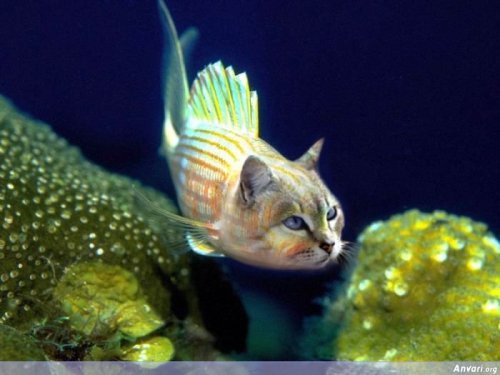
What would you call this "cat fish"? Image via sharenator.com

I am officially on summer vacation!! My family and I are getting ready to go on our annual road trip to Louisiana to visit my grandparents, but before I depart, I want to leave you all with a Name That Animal Challenge! If you did not get a chance to participate in my previous Name That Animal Challenge and would like to, go to Name That Animal Challenge: #1.

Pretend that you are a scientist and you have just discovered this new species of fish and you have the privilege of naming this unusual species. Scientists usually name new species by using Greek or/and Latin roots because the prefixes, stems, and suffixes are just like building blocks that you can utilize in countless ways.

Your challenge is to name the unique animal in the picture above using your knowledge of Greek and Latin roots. Keep in mind that you can use characteristics like size, color, or shape to name the animal. Feel free to search my blog to find root words to help you or use the list below.

Greek:

ichthy                           fish

cephal                          head

branch                         gills               *combining form is branchio-

morph                         form, shape

ailuro                           cat

Latin:

pisci                            fish

-iform                       shape               *used as a suffix

feli                              cat

corp                          body

I came up with ailurocephaloichthyomorph or cat headed fish form. I decided to use just Greek components and I linked each root with an o, the most common Greek connector. If you decide to use Latin, you may want to connect your roots with the letter unless the root already has the i connected like pisci.

Be creative and have fun! I can’t wait to read what you all come up with!

Insider’s Guide to the 2015 Scripps National Spelling Bee – Send-off Party!

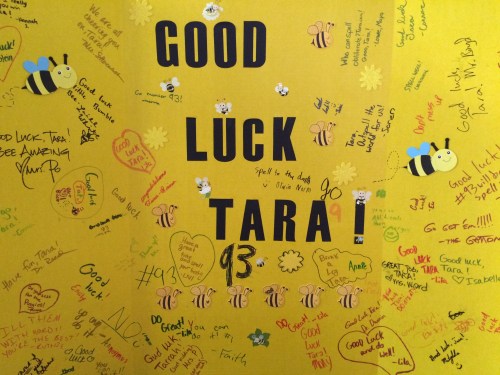
My amazing English teacher, Dr. Dworin, made this poster for my send-off party.

This week was very exciting for me because I was interviewed by Melissa Swan of WHAS11-TV for the evening news. My school also surprised me with a send-off party, which included chocolate ice cream and an original song written and performed by the elementary school students. I felt really honored when I received a gigantic poster made by my wonderful English teacher and signed by lots of students and teachers. I love everyone at my school because they all support me and are so thoughtful.

Bee Week starts tomorrow and I can’t wait!

Harry Potter Spells – Levicorpus

In the movie, Harry Potter and the Order of the Phoenix, Harry teaches the spell Levicorpus to Dumbledore's Army. However, this never happens in the book. (Photo from harrypotter.wikia.com)

Last week, I took a break from Harry Potter to talk about the Kentucky Derby but let’s return to exploring Harry Potter spells. Harry first discovers the spell “levicorpus” in Snape’s old potions book in Harry Potter and the Half-Blood Prince. 

Levicorpus comes from the Latin roots levi– meaning smooth or light and corp- meaning body. The spell “levicorpus” makes a body incredibly light, allowing it to float.

We discover the effects of the spell when Harry uses it against Ron. Harry pointed his wand “and the incantation sprang to mind without conscious thought: Levicorpus! Ron yelled as his heel was wrenched upward once more; he dangled helplessly, upside down, his robes hanging off him (Page 393).”

Can you think of another spell with the root word levi– in it?

Carpe Diem!

The 141st Kentucky Derby will occur on May 2, 2015. (Photo from kentuckyderby.com)

Here in Louisville (and probably all around the world), many of us are super excited to watch the Kentucky Derby later today!

My favorite amongst the field of horses is Carpe Diem, mostly because his name has an awesome meaning. Carpe diem is a Latin expression that means “seize the day.” The jockey who rides Carpe Diem also rode Animal Kingdom to victory in 2011. John Velazquez has ridden in thirteen previous Kentucky Derby races, so he is extremely experienced.

I hope that this beautiful and velocious horse seizes the day and rides to victory!