nix (niks)

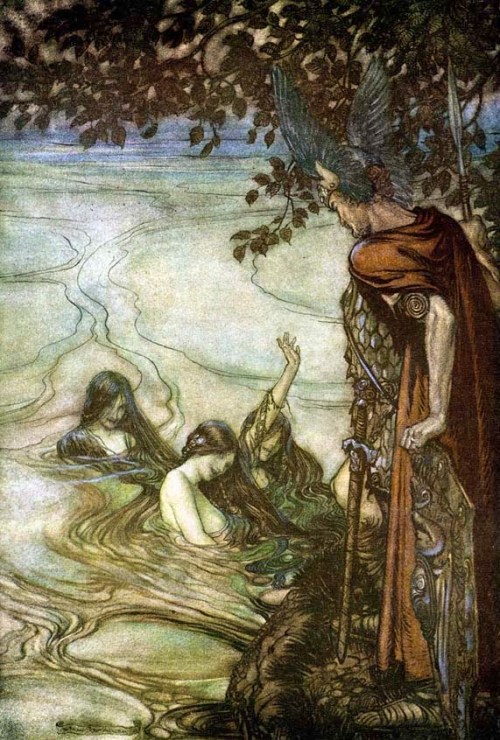
Nixes are water spirits who lure people to their watery graves. (Painting by Arthur Rackham, image from www.wikipedia.org)

Our first monster is a malevolent creature from Germanic folklore. Nixes are water spirits that live in rivers and lakes and lure people into the water to their deaths.

Nixes can take on many forms; males can shapeshift into humans, snakes, or fish, while females are commonly portrayed as beautiful women with the tail of a fish. A famous nix was the beautiful Lorelei, who perched atop a rock on the Rhine River and lured fishermen to their doom with the sound of her voice.

Beware the next time you go swimming in a lake, or else you might end up becoming a victim of a nix.

Coming Soon: Creature Feature

creature-feature-1

Artwork by my talented friend Lauren Prys

Halloween is almost upon us and I am so excited!

In honor of my favorite holiday, every week this month I will unveil a scary creature guaranteed to make you shriek in fright and lock your doors at night.

The first Creature Feature will be posted on October 8, so be sure to return to explore the morbid monster of the week. In the meantime, feel free to peruse my other Halloween related posts under the category “phobias.”

koekje (cook-yuh)

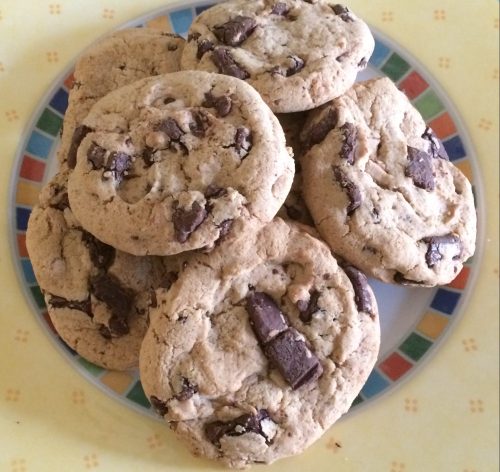
The chocolate chip cookie was invented by Ruth Wakefield in 1937.

Every country has its own word for “cookie,” a sweet confection that can be soft or crisp. The word “cookie” comes from koekje, a Dutch word that means “little cake.” Dutch immigrants brought the word “koekje” to North America when they began to settle in New Amsterdam (later called New York city) in the early 1600s. Koekje eventually became anglicized to “cookie”; the first known usage of the word occurs in 1703.

The most popular variety of cookie in the United States is chocolate chip. In 1937, Ruth Wakefield accidentally created the chocolate chip cookie when she substituted chunks of semi-sweet chocolate for powdered chocolate in a butter cookie recipe. Wakefield assumed that the chocolate chunks would melt like the powdered chocolate, but instead, the chunks retained their shape. Thus, the chocolate chip cookie was born! In 1939, Betty Crocker mentioned the chocolate chip cookie on a radio show, making it nationally famous.

If you are a resident of a country outside the U.S.A., what word do you use to refer to “cookie”? What is your favorite type of cookie?                                                                                                                                                                 

Sources:
History of Cookies. http://www.whatscookingamerica.com
Cookie. http://www.wikipedia.com
http://www.dictionary.com

gifblaar (gifˌblär)

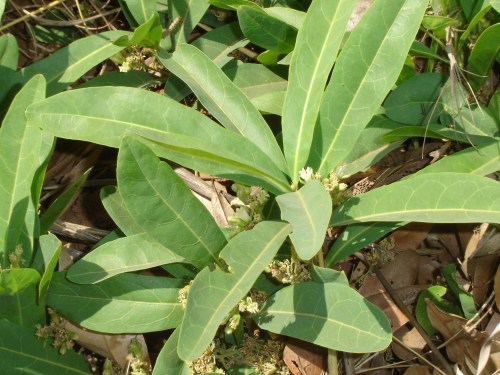
Gifblaar is a poisonous plant that is fatal to cattle in Southern Africa. (Image from en.wikipedia.org)

Hello everyone! Today, I’ve chosen to post about an unusual word from Afrikaans.

Afrikaans is an Indo-European language and is specifically part of the West Germanic language tree. It is the official language of South Africa and Namibia and is spoken by millions of people. Afrikaans is descended from Dutch, therefore, these two languages have similar language patterns. It is interesting to note that people who speak Afrikaans can also understand Dutch.

The word gifblaar comes from the Afrikaans roots gif, meaning poison, and blaar meaning leaf. The English translation for this word is “poison leaf.” Gifblaar is a poisonous plant native to Southern Africa and is toxic to cattle, causing death within hours of ingestion.


vexillology (veksəˈläləjē)


The Rio Olympics are well underway, making this a great time to engage in vexillology.

Vexillology is the study of flags. It originates from the Latin word vexillum, which means flag, and contains the Greek suffix -logy, which means study of.

There are 206 countries, each with their own unique flag, participating in this year’s Olympics. Some particularly fascinating flags belong to the countries of Nepal, Bhutan, and Japan. Bhutan’s flag depicts the national symbol of the country, Druk, the Thunder Dragon.  Nepal’s flag is the only flag in the world that is not rectangular or square; it consists of two pennants stacked on each other, which represent the peaks of the Himalayan mountains. Japan’s flag is beautiful in its simplicity – a solitary red disc, symbolizing the sun, on a white background.

The Olympic flag itself is quite interesting. It depicts five colorful rings, each of which represents a continent. The interlocking rings represent the unity of the continents and the meeting of athletes from all over the world.

Are any of you vexillophiles? If so, which flags are your favorite?

LEGO (lā-gō)

Many months ago, my family and I visited the Museum of Science and Industry in Chicago, Illinois. While we were there, we spent a majority of the time at the Brick by Brick exhibit. This exhibit featured gargantuan LEGO-built structures of famous landmarks from all around the world.

These buildings were awe-inspiring in their extreme attention to detail; each structure was made with thousands of LEGO bricks. My favorite structures were the Golden Gate Bridge, the Pyramids of Egypt, and the Colosseum in Rome.

LEGO is an abbreviation that comes from the Danish words leg and godt, which mean “play well.”  In Latin, “lego” means “I choose.” This seems to be the perfect name for a company that allows children of all ages to play with their product in any way they choose- limited only by their imaginations.

xenolinguist (zenə-liŋgwə̇st)

Nyota Uhura was portrayed by  Nichelle Nicols in the original Star Trek. Zoe Saldana currently portrays Uhura in the newer Star Trek movies. (Image from rottentomatoes.com)
Nyota Uhura was portrayed by Nichelle Nicols in the original Star Trek. Zoe Saldana currently portrays Uhura in the newer Star Trek movies. (Image from rottentomatoes.com)

Star Trek Beyond was released a few days ago and I couldn’t resist writing about one of my favorite Star Trek characters, Nyota Uhura. Lieutenant Uhura is the chief communications officer on the USS Enterprise. She is an expert in xenolinguistics and can speak and understand many alien languages, including Klingon and Romulan.

Xenolinguist comes from the Greek roots xeno-, meaning foreign, and lingu- meaning tongue. A xenolinguist is someone who is skilled in foreign languages, or in this case, alien languages.

I love this character because she is smart, resourceful, and strong.  Additionally, we both have a lot in common. We share a love of linguistics and our first names both mean “star.” Nyota means “star” in Swahili and Tara means “star” in Sanskrit. I would love to be a xenolinguist when I grow up!

pacific (pəˈsifik)

Last week, my family and I went on a relaxing vacation to beautiful Monterey, California. Monterey, a small seaside city on the central coast of California, is one of my favorite places to visit because of the mild weather and beautiful beaches. My sister and I love to stroll on the beach and hunt for sea glass that washes up from the Pacific Ocean.

The Pacific Ocean is the biggest ocean on Earth, covering 59 million square miles and containing more than half of the free water on Earth. The Portuguese explorer Ferdinand Magellan is responsible for naming this large body of water in 1520. Because of the calmness of the water, he named the newfound ocean “pacific.”

Pacific comes from the Latin root word pac- meaning peace or calm . The Latin suffix -fic means to make or do. The word “pacific” literally means “to make peaceful.” The word “pacific” is both a noun and an adjective. As a noun, the word refers to the “Pacific Ocean,” but when used as an adjective it means calm or tranquil.

Name That Animal: Challenge #4


zebraworth10000

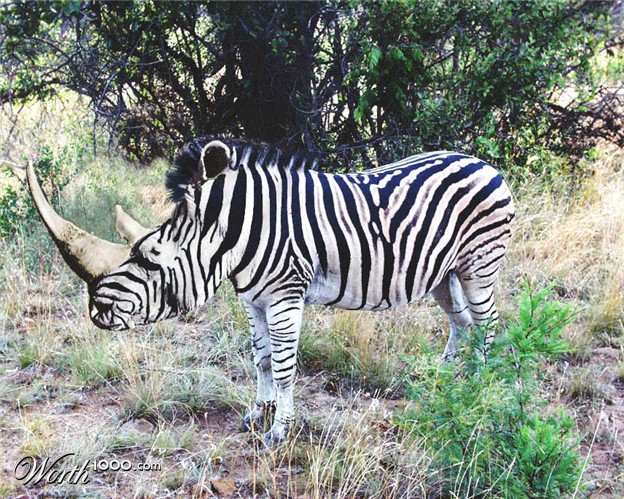
What would you name this fantastic creature?

I thought a Name That Animal Challenge would be a fun way to commemorate my 100th blog post!

Pretend that you are a scientist and you have just discovered this new animal and you have the privilege of naming this unusual species. Scientists usually name new species by using Greek or/and Latin roots because the prefixes, stems, and suffixes are just like building blocks that you can utilize in countless ways.

Your challenge is to name the unique animal in the picture above using your knowledge of Greek and Latin roots. Keep in mind that you can use characteristics like size, color, or shape to name the animal. Feel free to search my blog to find root words to help you or use the list below.

Greek:

hippo-, -hippus                             horse

cerat                                                   horn

morph                                               form, shape

cephal                                               head

Latin:

equi-, -equus                                 horse

corp                                                   body

ungul-, ungula                              hoof


I came up with biceratohippus or two horned horse. The letter “o” is the most common way to link Greek roots, while the letter “i” is used to link Latin roots. However, you can do whatever you like and have fun!

If you enjoyed this activity,  try  Name That Animal Challenge #1, Name That Animal Challenge #2,  and Name That Animal Challenge #3.


Hi everyone! I’ve created a new page on my blog called “Books To Explore.”  On this page, you’ll find a list of some of my favorite books. Since reading is a wonderful way to discover words, I thought this would be a great addition to my blog. Let me know what you think!