ailurophobia (ī-ˌlu̇r-ə-ˈfō-bē-ə)

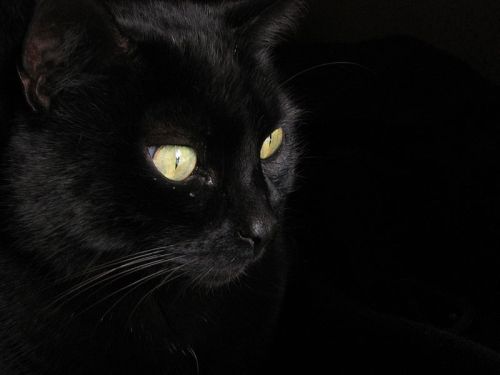
Ailurophobia is the fear of cats. "Gato negro" by Chosovi. Distributed under license CC BY-SA 2.5 via Wikimedia Commons.

As Halloween approaches, people are busy decorating their houses with scary looking spiders, skeletons, and witches. Images of black cats are also a common decoration for Halloween; I see black cats with haunting eyes everywhere! In the United States, black cats are considered bad luck. But in other countries, like Japan, black cats are thought to bring good luck. For the last several months, a black cat has been roaming around in our yard. We see him almost every day. I like to think that this means that we will have good fortune!

Ailurophobia is the abnormal fear of cats. Ailurophobia comes from the Greek roots ailur- meaning cat and phobia meaning abnormal fear of. I know many more ailurophiles than ailurophobes – which one are you?

iatrophobia (īa‧trə-ˈfōbē-ə)

Iatrophobia is the fear of doctors.

Halloween is approaching at the end of the month and I am so excited! This is one of my favorite holidays; it’s a day to dress up in costumes and go trick-or-treating. It is the only day of the year my mom allows my sister and I to eat lots of candy and stay up later than usual.

Last year, I explored phobias during the month of October, and I thought it would be fun to continue the theme.

One of my biggest fears is going to the *pediatrician’s office, especially when I need to get vaccinated. I feel dizzy and nauseous when a needle approaches. Iatrophobia is the abnormal fear of doctors. It comes from the Greek roots iatro– meaning physician or medicine and –phobia meaning abnormal fear of.

Do any of you have iatrophobia?

*The root word –iatr can be found hiding in the middle of words, such as in the word pediatrician – a doctor who specializes in children’s medicine.

If you want to explore other phobias I’ve written about, search my blog with the key word “phobia”.

lipogrammatism (lipəˌgramə ti-zəm)

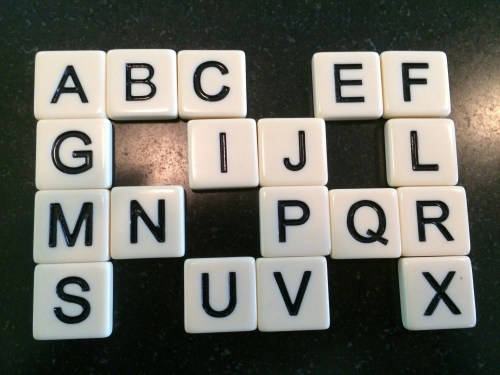
Lipogrammatism is a style of writing in which a letter or group of letters is excluded from a literary work.

Happy October! Recently, my English class received an unusual writing assignment from our teacher. Our assignment was to write a detailed description of our faces. This seemed easy enough, but there was a catch. We could not use the letter “s”.  I thought this was going to be an impossible task. How was I supposed to describe my ears, lips, earrings, eyes, or glasses without the letter “s”?!

This style of writing in which a certain letter or group of letters is excluded is called lipogrammatism. Lipogrammatism contains the Greek roots *lipo- meaning lacking or without and –gram meaning something written. The Greek word “gramma” means letter. The word lipogrammatism literally means “lacking a letter.”

For me, this was a challenging assignment. My teacher said that the result was likely to be “odd” and indeed it was. Below is an excerpt of my lipogram:

I have thick, refulgent, long black hair. I have a wide grin with mainly permanent teeth. Each dark chocolate colored ocular organ is framed by long curved blepharal hair.  I detect fragrance or odor with a narrow bridge in the center of my face. Upon the bridge, I wear a purple hued myopia correction device. I have a dimple in my cheek. I wear a tiny, gold hoop earring in each earlobe.

Have any of you written a lipogram before? If so, I would love to read it! Please post a link or paste it onto a comment. For those of you who have never written a lipogram, I challenge you to do this assignment and post it below in the comments.

*The Greek root –lipo also means fat

petroglyph (pe‧trəˌglif)

I hope you all enjoyed my previous post on pahoehoe! During our visit to the Big Island of Hawai’i, we hiked over fields of pahoehoe to see the ancient Pu’u Loa petroglyphs in Hawai’i Volcanoes National Park.

The word petroglyph contains the Greek roots petro– , meaning rock, and glyph, meaning carving or engraving. Petroglyph literally means “rock carving.”

The Pu’u Loa petroglyphs were carved many centuries ago by native Hawaiians. Since the ancient Hawaiians didn’t have a written language, they created petroglyphs to express what was important to each of them. I was in awe of the sheer number of petroglyphs; this site contains approximately 15,000 images that have been engraved in pahoehoe. Some of the images we saw included human forms, insects, and geometric shapes. We spent a lot of time poring over the images and contemplating the meaning behind the petroglyphs.

pahoehoe (pəˈhōē hōē)

This summer, my family and I visited Hawai’i for two weeks. It was my first time going to Hawai’i and I loved it! We spent time on both Maui and the Big Island. Both islands were very pretty yet very different. Maui is older than the Big Island, has beautiful beaches and is very lush. The majority of the Big Island had seas of lava rock as far as the eye could see.

The Big Island is the biggest and youngest of the Hawaiian archipelago. The lava flowing from the two most active volcanoes in the world, Kīlauea and Mauna Loa, is responsible for the still growing island. We spent a week on the Big Island and while we were there, we visited the Hawai’i Volcanoes National Park. One of the coolest sites was the lava lake at the Kīlauea Summit. We went at night and the steam rising from the vent glowed a brilliant red.

As we drove through the park, we saw fields of pahoehoe. Pahoehoe is lava that has a smooth, shiny or often swirled surface. Pahoehoe comes from the Hawaiian word hoe, which means to paddle. Since the surface of pahoehoe resembles the ripples made in the water by a paddle, the name is very fitting. Hawaiian words are fun to say because they often repeat a sound within a word, like humuhumunukunukuapua’a (fish) or muumuu (dress).

eulogy (yüləjē)

A eulogy is a speech or composition in praise of someone, especially one who has recently passed away. Eulogy comes from the Greek roots eu meaning good and log meaning word. It literally means “good words.”

Midas was an adorable 14-year-old canine member of our family who passed away unexpectedly on July 23, 2015. Midas was a Tibetan Spaniel, an intelligent and loyal breed of dog that originated in the monasteries of Tibet over 2000 years ago. He was a beautiful golden color and was named after King Midas from Greek mythology who had the golden touch.

Midas was the best dog ever! I will miss him sitting near me as I studied for spelling bees or did my homework. He was always the first one to greet my dad with wagging tail and joyful yelps after a long day of work. My sister misses feeling his soft fur and hearing the pitter-patter of his paws on the hardwood floors. My mom will never forget how he needed to hide his stuffed animal pig after he ate.  We all smile thinking about how he would spend a long time trying to figure out where to hide his precious pig, only to hide it in the middle of the floor!

His favorite activity was waiting for the mailman, even on Sunday, so that he could attack the mail as it came through the mail slot. In Tibet, Tibetan Spaniels would perch atop the monastery towers and alert the monks when they saw people approaching. True to his breed, Midas would always alert us when he saw anyone approaching the house. He did not like strangers but he sure did love his family.

We know that Midas loved us as much as we loved him. We are all sad that he is gone, but he will never be forgotten.

agathokakological (a-gə-thō-ka-kə-lä-ji-kəl)

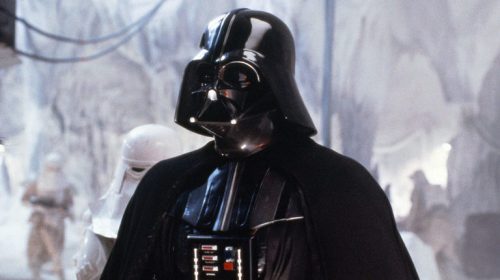
Darth Vader is agathokakological; he is both good and bad. Image from www.starwars.com

Happy Fourth of July everyone! I hope you all are having a great summer so far. This summer, I plan to watch all of the Star Wars movies again to prepare for the new movie, The Force Awakens, which premieres at  the end of the year. One of the most interesting characters in the series is the agathokakological Darth Vader because he not only looks cool, he is also a skilled pilot as well as an accomplished light saber duelist. Agathokakological is an adjective that means composed of both good and bad. The word comes from the Greek roots agatho meaning good and kako meaning bad.

Darth Vader starts out as Anakin Skywalker, a Jedi Knight who protects the Republic and helps to prevent the Separatists from dominating the galaxy. But then, he is tempted by the Dark Side by Emperor Palpatine, also known as Darth Sidious. Sidious corrupts Anakin and successfully turns him to the Dark Side. Anakin then becomes the feared Darth Vader and spreads terror throughout the Empire. However, at the end of the sixth movie, Darth Vader shows that there is still good in him when he saves his son, Luke, from being killed by the evil Darth Sidious. 

Are you a Star Wars fan? If so, who is your favorite character?

Name That Animal: Challenge #2

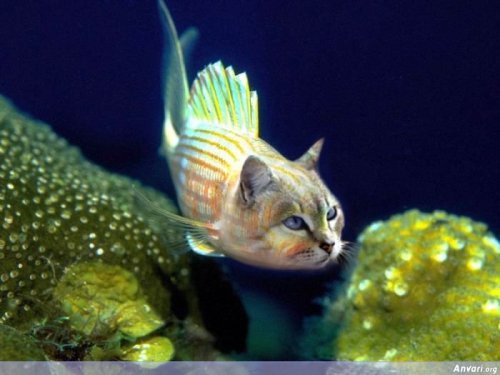
What would you call this "cat fish"? Image via sharenator.com

I am officially on summer vacation!! My family and I are getting ready to go on our annual road trip to Louisiana to visit my grandparents, but before I depart, I want to leave you all with a Name That Animal Challenge! If you did not get a chance to participate in my previous Name That Animal Challenge and would like to, go to Name That Animal Challenge: #1.

Pretend that you are a scientist and you have just discovered this new species of fish and you have the privilege of naming this unusual species. Scientists usually name new species by using Greek or/and Latin roots because the prefixes, stems, and suffixes are just like building blocks that you can utilize in countless ways.

Your challenge is to name the unique animal in the picture above using your knowledge of Greek and Latin roots. Keep in mind that you can use characteristics like size, color, or shape to name the animal. Feel free to search my blog to find root words to help you or use the list below.

Greek:

ichthy                           fish

cephal                          head

branch                         gills               *combining form is branchio-

morph                         form, shape

ailuro                           cat

Latin:

pisci                            fish

-iform                       shape               *used as a suffix

feli                              cat

corp                          body

I came up with ailurocephaloichthyomorph or cat headed fish form. I decided to use just Greek components and I linked each root with an o, the most common Greek connector. If you decide to use Latin, you may want to connect your roots with the letter unless the root already has the i connected like pisci.

Be creative and have fun! I can’t wait to read what you all come up with!

Insider’s Guide to the 2015 Scripps National Spelling Bee – Awards Banquet and Party

The morning after the Championship Finals, spellers had the opportunity to explore D.C. We decided to go to the National Air and Space Museum which was interesting.

That evening, we attended a fancy Awards Banquet, at which we honored the ten finalists. Afterwards, we all went to the Cherry Blossom Ballroom for a dance party that lasted until midnight!

Participating in the National Spelling Bee the second time around was more fun because I knew what to expect and spelling on stage wasn’t as overwhelming as my first time. The Bee is a great place to meet kids from all over the world and forge friendships that will last a lifetime! It was amazing to be surrounded by so many people who share my love of words! 

I hope you all enjoyed the Insider’s Guide to the 2015 Scripps National Spelling Bee. I know that I certainly enjoyed writing it!

Insider’s Guide to the 2015 Scripps National Spelling Bee – Championship Finals

Vanya Shivashankar and Gokul Venkatachalam were declared co-champions of the 2015 Scripps National Spelling Bee!!

I watched in amazement as these two spellers exhausted a list of 25 extremely difficult championship level words! Gokul spelled the word nunatak for the win. Nunatak is a hill or mountain surrounded by glacial ice. On the road to the championship, Gokul also spelled filicite, Sprachgefuhl, nixtamal, and pipsissewa. Vanya’s winning word was scherenschnitte which is the art of decorative paper cutting. Along the way, Vanya also had to spell zimocca, tantieme, urgrund, and Bruxellosis.

It takes lots of hard work and dedication to just qualify for the National Spelling Bee so I’d like to say congratulations to every single speller who participated this year!