Insider’s Guide to the 2018 Scripps National Spelling Bee – Opening Ceremony

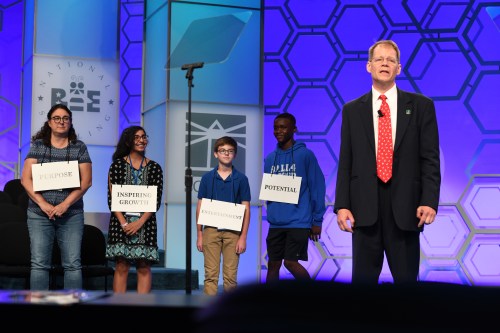
2018 Scripps National Spelling Bee Opening Ceremony.

Hello everyone!

Tonight the 2018 Scripps National Spelling Bee officially kicked off with the Bee’s Opening Ceremony! I was honored to be a part of this year’s ceremony as a representative of one of the seven core values of the Bee – inspiring growth. Other values include purpose, achievement, entertainment, potential, discovery, and heritage. During the ceremony, Dr. Bailly, the official pronouncer of the Bee, highlighted the fact that my blogging was inspiring others to grow in their knowledge as I have grown during my five year journey at the Bee. Indeed, that was my hope for this blog and I hope I have succeeded in that endeavor.

Over the past three years, I have written about my Bee experiences in my Insider’s Guide to the Scripps National Spelling Bee. However, this year I have decided to forego this tradition and simply enjoy my last time at the Bee (I’m an 8th grader and will no longer be able to compete after this year).

The National Spelling Bee is a great event and I hope you all get a chance to watch it this year; my speller number is 133! If you are competing in the Bee this year, good luck!

Additional information and broadcasting schedule can be found on http://www.spellingbee.com.

eradicate (ə̇ˈradəˌkāt) vs. irradicate (ə̇ˈradə̇ˌkāt)

Hello everyone! To continue our homonym theme, let’s take a look at this confusing pair of homophones – eradicate and irradicate. You may remember from an earlier post that homophones are words that sound the same, but are spelled differently.

Both eradicate and irradicate come from the Latin word radix, which means root. However, these words have opposite meanings due to their prefixes. Eradicate contains the Latin prefix e- which means out of, giving rise to its meaning “to uproot” or “root out”. One could use the word “eradicate” in terms of a cure for a disease (the disease was completely eradicated).

Irradicate on the other hand means to root deeply within. It refers to something that cannot be “rooted out” or “destroyed.” This word has gone through assimilation, the process by which the final letter of the prefix is dropped, and the first letter of the root is doubled. In this case, the prefix “in” (meaning in or within), has changed to ir-radicate. Even though assimilation has occurred, the meaning of the original prefix remains. Assimilation often occurs with words derived from Latin in which a prefix is linked to a root. 

I hope you enjoyed reading about this interesting pair of words!


One of my favorite things to eat is pasta. I could eat fettuccine, linguine, penne and farfalle every day and not ever get tired of it!

Stewart Edelstein, the author of Dubious Doublets: A Delightful Compendium of Unlikely Word Pairs of Common Origin, from Aardvark/Porcelain to Zodiac/Whiskey has created a fun pasta quiz on Merriam-Webster online. As you take the quiz, you’ll notice that the origins of many of the Italian words for the various pastas derive from Latin. This is because Italian is a Romance language. Other Romance languages include Spanish, French, and Portuguese. Romance languages come from Vulgar Latin (vulgus is a Latin noun that means “common people” or “general public”), a form of Latin that was spoken by commoners in Rome during the 2nd – 4th centuries.

Take the quiz and be sure to let me know how you did!


Bluegrass Literacy Project

Hello everyone! I haven’t posted in a while and I wanted to give you all an update.

Last fall, I submitted a project proposal to the Davidson Institute for Talent Development to be a part of their Young Scholars Ambassador Program (YSAP). This program “fosters civic engagement through community service, volunteerism and leadership” (from the Davidson Institute website).

In December, I found out that I had been accepted into the Class of 2019 Young Scholar Ambassadors. For the next 18 months, I will be working to develop and implement my project, which I’ve named the Bluegrass Literacy Project. Through my project, I hope to continue to share my love of words and make a positive and lasting impact in my community. You can read more about my project here.

I’m really excited about this opportunity, but unfortunately it also means that I may not be posting as much as I would like on this blog. However, I will do my best to continue posting interesting words as time permits. Thank you all for your support and encouragement!