Harry Potter Spells – Levicorpus

In the movie, Harry Potter and the Order of the Phoenix, Harry teaches the spell Levicorpus to Dumbledore's Army. However, this never happens in the book. (Photo from harrypotter.wikia.com)

Last week, I took a break from Harry Potter to talk about the Kentucky Derby but let’s return to exploring Harry Potter spells. Harry first discovers the spell “levicorpus” in Snape’s old potions book in Harry Potter and the Half-Blood Prince. 

Levicorpus comes from the Latin roots levi– meaning smooth or light and corp- meaning body. The spell “levicorpus” makes a body incredibly light, allowing it to float.

We discover the effects of the spell when Harry uses it against Ron. Harry pointed his wand “and the incantation sprang to mind without conscious thought: Levicorpus! Ron yelled as his heel was wrenched upward once more; he dangled helplessly, upside down, his robes hanging off him (Page 393).”

Can you think of another spell with the root word levi– in it?
Harry Potter Spells – Sectumsempra

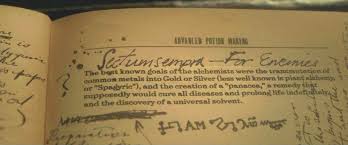
Harry finds "sectumsempra" scribbled in his borrowed potions book. Photo from harrypotter.wikia.com

During the next couple of weeks, I would like to explore some spells utilized in Harry Potter. Sectumsempra is a curse created by Severus Snape, the Half-Blood Prince.

Sectumsempra can be broken down into two different Latin words – sectum meaning cut and semper meaning always. Sectumsempra most likely means “always cut.”

In Harry Potter and the Half-Blood Prince, Harry casts the spell, then watches in horror as “blood spurted from Malfoy’s face and chest as though he had been slashed with an invisible sword” (Page 522).

Harry Potter Characters – Severus Snape

Severus Snape definitely lives up to his name! Photo from harrypotter.wikia.com

Let’s explore another charactonym used in Harry Potter! If you recall, a charactonym is a name that suggests a certain trait about a fictional character. Severus Snape is the feared Potions Master of Hogwarts and later becomes the Defense against the Dark Arts teacher.

The Latin word severus means strict and Severus Snape definitely lives up to his name. Snape is described as a “teacher with greasy black hair, a hooked nose, and sallow skin” (Pg 126). “His eyes … were cold and empty and made you think of dark tunnels (Pg 136). He “criticized almost everyone” (Pg 139) and especially loved to deduct points from Gryffindor for any minor offense. According to Ron, he could “turn very nasty” so it was probably best not to anger him (Pg 139).

*Quotes cited from Harry Potter and the Sorcerer’s Stone by J.K. Rowling.

Harry Potter Characters – Remus Lupin

J.K. Rowling uses lots of charactonyms throughout the Harry Potter series. Merriam Webster defines charactonym as “a name  for a fictional character  that suggests a distinctive trait of the character.”  In Harry Potter and the Prisoner of Azkaban, a new Defense Against the Dark Arts teacher is hired and his name is Remus Lupin. Lupin is very similar to the word lupine,  an adjective which means of or relating to a wolf.  Lupine comes from the Latin word lupus meaning wolf.  Lupin’s name betrays what he actually is, a werewolf! I like trying to decipher the charactonyms that J.K. Rowling uses in her books, because it makes the books more interesting and exciting.


funambulist (fyu̇-ˈnam-byə-list)

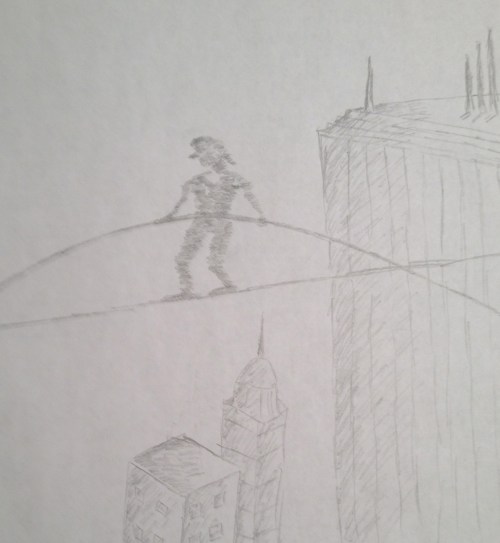
A sketch of a funambulist drawn by my dad.

A funambulist is a tightrope walker. Funambulist contains the Latin roots fun– meaning rope and ambul– meaning walk. This word literally means “rope walker!” One of the most famous funambulists is Jean-Francois Gravelet, known as “The Great Blondin”. In 1859, he crossed the Niagara River on an 1100 foot rope. He crossed the river many times, each time doing something more dangerous. He ran and biked across, even in the dark! I think that his most amazing feat was when he rolled a wheelbarrow containing a stove, to the middle of the rope, stopped and cooked an omelet, then lowered the omelet to passengers in a boat below him! I don’t think that I could ever be a funambulist, because I would be too scared and probably end up falling!

campanula (kam-pan-yə-lə)

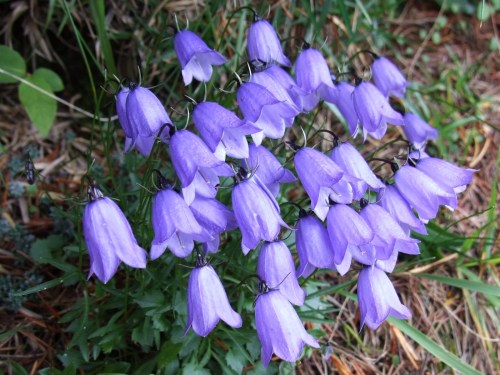
This picture shows the little bell shaped flowers of the campanula. (Photo credit to Wikipedia)

This week we will be exploring the word campanula, commonly known as the bellflower. Varieties of this plant include biennials, annuals and perennials. For those of you who may not know, a biennial plant is a plant that grows leaves, roots, and stems in its first year of development and flowers during the second year. The flowers of the plant come in many different colors, including white, lavender, pink and blue. Campanula comes from the Latin root campan, which means bell and includes the suffix -ula meaning little. As you can see in the picture, the flowers really do look like little bells.

aquilegia (a-kwə-lē-jē-ə)

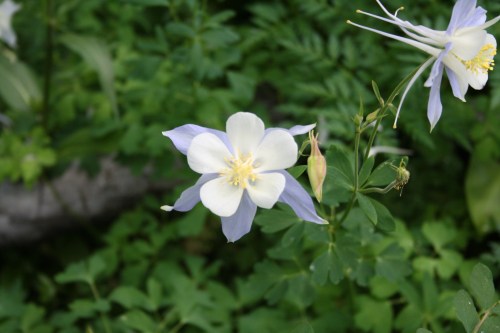
Rocky Mountain Columbine, the state flower of Colorado.

Spring is in the air and I decided to get to the roots of different flowers (yes, I know that’s a bad joke).  Let’s explore the word aquilegia, also known as columbine.  These beautiful flowers have delicate petals and have a star shape with yellow centers.  Some have long spurs that fan out behind the blossom.  Aquilegia comes from the Latin root aquil, meaning eagle. It is named this because the flower petals look like an eagle’s claw.  The Rocky Mt. Columbine, shown in the picture, has been Colorado’s state flower since 1899. Can you think of any words with the root aquil in them?